

DISD Implementation of New Math Curriculum Gets Notice from State
Decatur ISD math classrooms recently received a special visit from educational leaders with the Texas Education Agency and Region 11, thanks to the district's strength with its math curriculum.
The fall visit gave three guests — Katie Hawley, a contracting representative with the Texas Education Agency, and Region 11 Reps Lindsay Carrier and Bettina Edwards-Wilson — a chance to quietly observe teachers and students in action using this curriculum, Bluebonnet Learning.
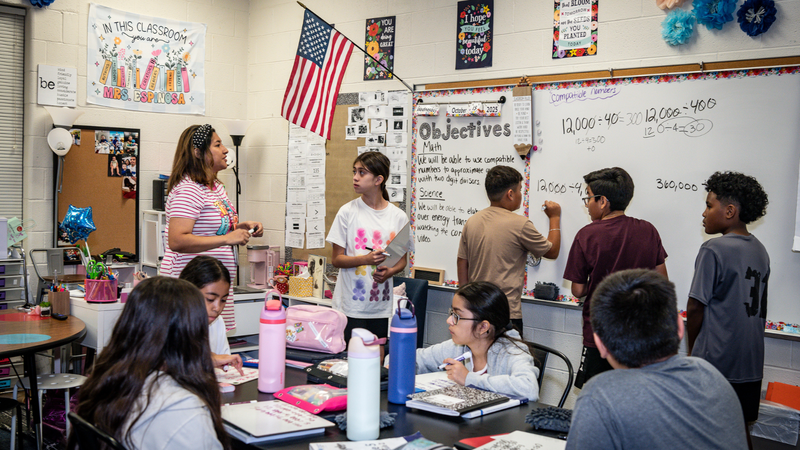 For their first visit, the guests and a handful of DISD administrators slipped into Blanca Espinoza’s 5th grade bilingual classroom at Rann Elementary.
“Now, we’re going to estimate and divide,” said Espinosa, as students prepared for a new equation. “I want you to write the first question on your board: 812 divided by 39. I’ll give y’all a few seconds.”
For many students, the answers came readily.
For those who struggled, Espinoza resisted the natural tendency to provide the answer, a technique encouraged in Bluebonnet. Instead, she challenged stuck students to problem-solve with their groups.
“She is so precise with the way that she supports them,” said Hawley, a new teacher project coordinator with the Strong Foundations Grant, a $679,000 fund DISD received to help pay for Bluebonnet implementation and professional development tools. “You can just tell that they are just used to it. It’s not a show for us. This is what they do in the classroom day in and day out.”
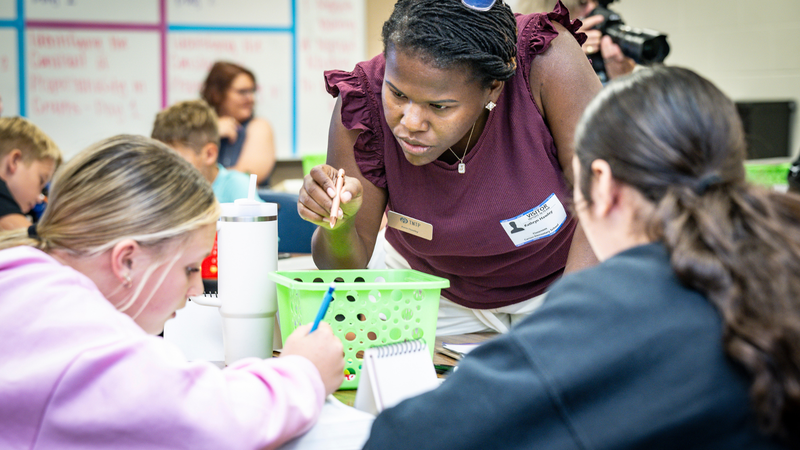 She added that she was particularly impressed with how Espinoza responded to incorrect responses.
“It was beautiful to watch the way she held them responsible for doing the thinking and the talking," Hawley said during a hallway recap. “I loved hearing her voice less and their voices more.”
The Texas Education Agency, the state's education governing body, created Bluebonnet Learning as a no-cost system of instruction to align public schools with the Texas Essential Knowledge and Skills teaching standards. Still in its first year, the program is built on the latest scientific understandings of how people learn and research-based instruction. Elementary teachers at Carson, Rann, the STEM Academy, and Young have been using a similar curriculum for three years, a beneficial head start. McCarroll Middle School teachers and Decatur High School Algebra I teachers began using the system this school year. The goal is to deepen knowledge and improve student test scores for NWEA-MAP, an internal assessment program, and State of Texas Assessments of Academic Readiness (STAAR) exams.
It can take three years to fully master any new curriculum. DISD teachers embraced the challenge.
Change that Adds Up
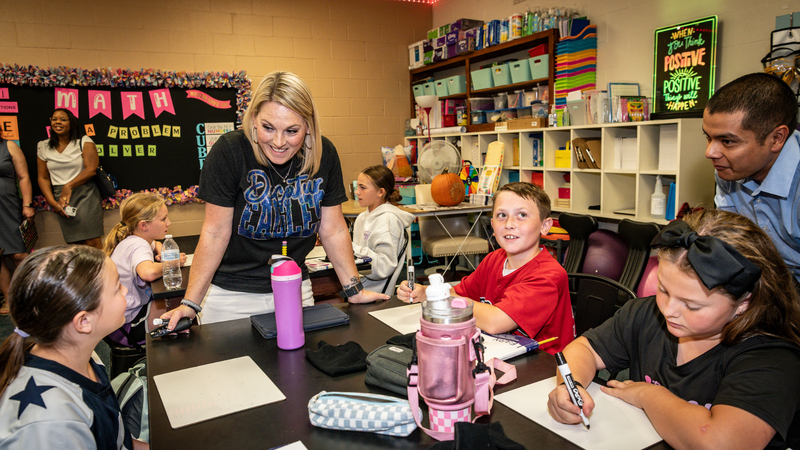 5th Grade Teacher Tiffany Bearden says she’s seen meaningful progress.
“Students are thinking more critically, solving problems more confidently, and beginning to understand the ‘why’ behind concepts such as place value and number relationships, rather than just memorizing steps,” said Bearden, a veteran 5th grade teacher who earned the title of Rann’s 2024-25 Teacher of the Year. “While grades don’t tell the whole story, I’ve noticed increased engagement and confidence—students are reasoning through problems, explaining their thinking, and applying their knowledge in new situations.”
“This conceptual growth is far more meaningful than grades alone,” she added.
During the visit to Bearden's classroom, students retrieved mini whiteboards as the guests watched.
“Guys I don’t want you to start yet because we’re going to brainstorm first,” Bearden started. “Our problem is 420 divided by 10. What are three ways we can solve this problem?”
A student quickly raised her hand.
 “No, don’t raise your hand,” said Bearden, using a Bluebonnet approach. “I want you to talk about it with your table. Find three ways we can solve this problem and then we’re going to talk.”
“I loved that student-to-student discourse was common in her classroom,” said Carrier, a Region 11 guest.
“It’s a higher level of learning that lets kids figure out what works for them,” said Aimee Wood, the district’s math and science coordinator. In Bearden’s class, “there was never just one way to solve a problem. Every time, she asked ‘how many different methods can you use?’”
Learning Beyond the Textbook
For today’s teachers, the challenge is leading instruction in ways that differ from how they were taught. Past math instruction often emphasized rote memorization and one-formula lessons.
But the reality is that many equations have multiple solution paths.
“Building strong foundational math skills at a young age is critical because these early concepts serve as the building blocks for future learning,” said Bearden.
“The curriculum is more rigorous, and having a solid foundation helps students feel prepared as the content becomes increasingly complex.," she continued "One of the curriculum’s greatest strengths is its intentional focus on math vocabulary. Students are consistently exposed to key terms and language, which deepens understanding and builds confidence in applying new concepts. Without this focus, students can become frustrated or fall behind.”
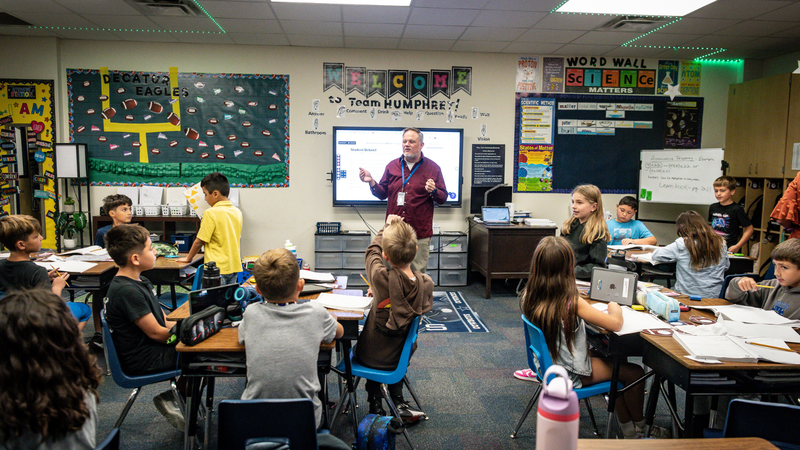 Carson Elementary 4th Grade Teacher Cliff Humphrey agreed.
“Math is like a story that builds on itself, and if students miss key pieces early on, it becomes much harder for them to keep up later,” said Humphrey. “I want my students to understand the “why” behind the math, not just to memorize steps. The Bluebonnet curriculum focuses on helping students grasp concepts deeply, which will set them up for success in the long run.”
Humphrey said that his student math scores are also trending up.
“We do not have official state assessment results yet, but I am encouraged by how my students are doing,” said Humphrey. “They are starting to show real growth and seem to be grasping the concepts more confidently. I am eager to see how this progress will be reflected in their MAP and STAAR scores.”
Humphrey started teaching months ago after years in the medical field as a supply chain manager.
“The district’s leadership and Bluebonnet training have been incredibly helpful. The professional development helped me understand the goals and gave me practical classroom strategies,” he added.
“He came to this campus last year around Christmas, never having stepped foot in a classroom,” said Wood. “His growth has been just amazing. That classroom has quite a few students in our special education program and at least one student in our behavioral education program, without an aide, learning at the same pace. Two years ago, for them to fully keep up, that would not have been possible.”
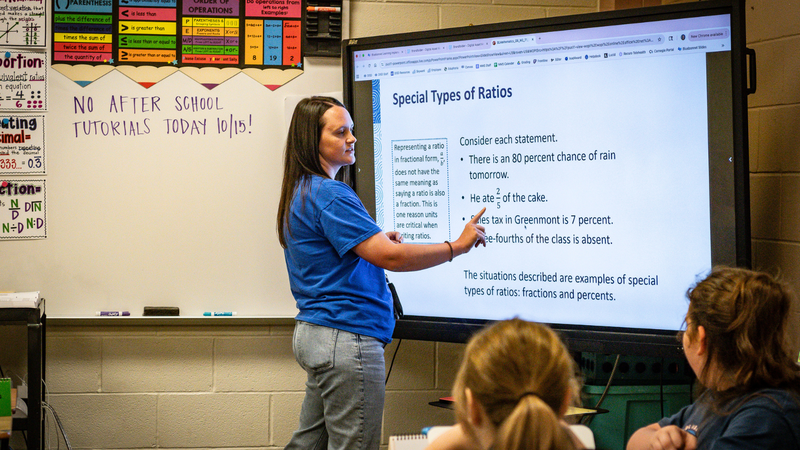 The visitors also stopped by McCarroll, where Kendra Longbrake led a fun, Bluebonnet-inspired prompt.
“These two girls were talking back and forth and trying to solve the problem for which mascot is preferred,” recalled Hawley. The pair initially struggled with the solution until one of the students suddenly gasped, exclaiming, “‘We forgot to add it together, girl!’”
“The culture of self and peer-to-peer correction is something I’ve never seen before,” said Hawley.
Bluebonnet materials include scripted guides and questions; timed lessons to aid teachers with pacing; post-lesson debriefs to reinforce instruction; and teachers’ editions of books.
“Mrs. Longbrake was the first person who went back to the teacher’s edition. She had it digitally, but it didn’t feel like she was reading a script,” said Hawley. “That practice needs to be encouraged. We are not expecting teachers to be robots and to memorize every single thing, but the way she did it was masterful.”
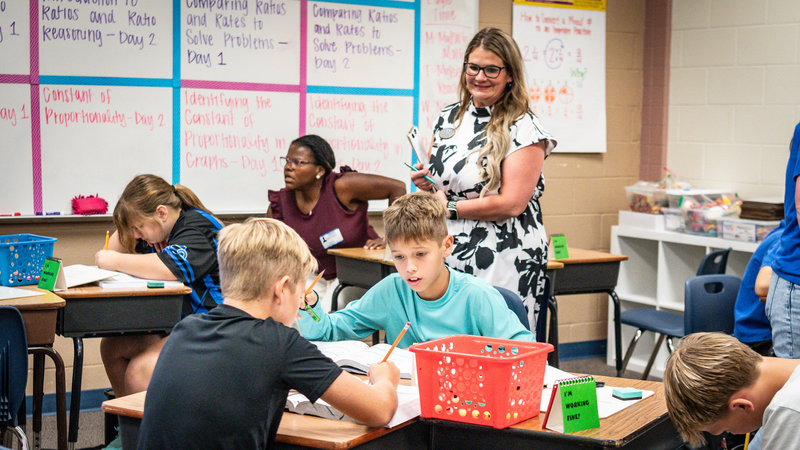 “They’re all implementing Bluebonnet beautifully, and I'm very proud of our teachers,” said Wood. “This work has been and is hard, so I think that our teachers felt good to show off what they’ve been doing.”
Both Humphrey and Bearden agree.
“I am excited to continue this journey,” said Humphrey. “It has been a great gift for my classroom, and I am hopeful that it will help my students build a strong math foundation and develop into confident, capable learners. These resources help my students but also make me a better teacher.”
“When I first began working with the curriculum, it felt like a lot—there was so much vocabulary to teach and resources to navigate on the platform,” added Bearden. “It was overwhelming at first, but I remind myself, just as I tell my students, ‘We can do hard things—it’s just new.’”